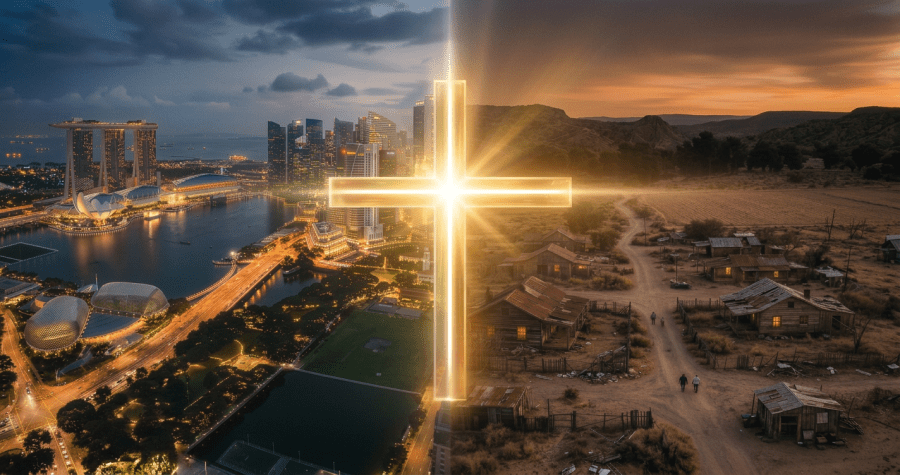
Life is beautiful, but also miserable. How can something be beautiful and ugly at the same time?
In one part of the world, we see people are celebrating successes: athletes win trophies they have long dreamed of, workers get promoted in their jobs, businessmen or politicians travel the globe, married couples welcome new precious lives in their families, and so forth.
In a stark contrast, in another part of the world, people are suffering tremendously—whether it is due to earthquakes, floods, wildfires, diseases, airplane crashes, road accidents, premature deaths, crimes, martyrdoms, or any tragic events that we could find on the news daily.
How can one person be so wealthy and successful—at least by human standards—while another person be so destitute and unfortunate? And even more complicated: how can some people become so rich from their corruption or wickedness, while at the same time innocent children and babies become victims of wars?
A person’s day of mourning may be another person’s day of laughing. A person’s time of suffering may be another person’s time of rejoicing. A person’s season of famine may be another person’s season of harvest.
Life seems unfair… or is it unfair? Is there still hope here? If you’ve struggled with these questions, you are not alone.
First, from the bottom of my heart, I am deeply sorry for all those experiencing or going through the unimaginable and incomprehensible tragedies in their lives. I acknowledge that we may never have the complete, correct, and comforting answers on this side of eternity.
In the painful moments, we may rightly ask, “Why?” or “What does this mean?” because, deep down, we know tragedy should not be our destiny. With all our limited knowledge and understanding, we want to make sense of them, so we could hopefully still find comfort through all that happened.
I know it is easy for me or anyone to write a few words of comfort and encouragement when we do not experience the hardships ourselves. Nevertheless, here I would still like to offer a few concise thoughts about making sense of this seemingly unfair life through a Scriptural viewpoint, while admitting that I would not have perfect answers or solutions to those problems or mysteries.
1. The meaning and purpose of life can only be found in the presence of God
God is the Source of Life and every good thing in life (James 1:17). Therefore, in the absence of God, life is meaningless. If we take God from the equation, all our efforts and struggles in this life would be in vain. In other words, life is indeed unfair if there is no God. Without God, life would be dead-end: no hope, no future. This means that our successes and achievements are also meaningless without God, who is the true and righteous Judge from whom “we will receive whatever we deserve for the good or evil we have done in this earthly body” (2 Corinthians 5:10). In contrast, our sufferings and afflictions are not meaningless in the presence of God. In fact, we can ultimately ‘find’ [and be found by] the One true God through troubles and hardships because “the Lord is close to the broken-hearted and saves those who are crushed in spirit” (Psalm 34:18). Some tragedies might be allowed by God to bring us to repentance—to turn away from evil and turn toward Him—with genuine acknowledgment that apart from Him we can do nothing. Some might be used by God to lovingly discipline us, to teach us more important lessons, and to open our eyes that the meaning and purpose of life will never be found in earthly things, but in Him alone (Luke 12:15; 1 Timothy 6:17). Some might be used to purify us and to display His power and glory even through our weaknesses and brokenness (James 1:2-4; 2 Corinthians 12:9). When life seems unfair, may we seek God and be soaked with wisdom and strength in His presence.
2. Sufferings and deaths reveal our deepest need for the Savior
When life is hit by things or forces beyond our control, like storms and natural disasters, we will soon realize our powerlessness and, hence, our desperate need for rescue. We may rightly hope human institutions or governments for help, but they are also limited in power. Our deepest, ultimate need is for the Almighty God Himself, who is infinite in power, wisdom, and love. The question now is which God? Scriptures reveal there is only one true God who truly cares for and can save His people: He is the LORD (Isaiah 41:13; Psalm 46:1; Psalm 121:1-2) who has come to this world as the Savior (Matthew 1:21; Luke 19:10; John 1:29; 1 John 4:14). Because of His great love, God gave us His Son, Jesus Christ, so we can know Him and live forever with Him (John 3:16). Jesus did not go through an easy path to save us: He stepped down from glory, by becoming fully human, and went through the cross—excruciating pain and undeserved death—despising the shame and rejection, so we can be reconciled to God. In doing this, Jesus offered Himself as the perfect sacrifice for our salvation and identified with us in suffering and death—sharing our deepest human reality. Every time we suffer and/or witness death, we can remember the Cross and, ultimately, embrace the Christ. He understands what you and I are going through. Some tragedies might remain a mystery, but He has promised to never leave us alone; His words are true because He practiced what He preached. When life seems unfair, may we draw near to God, call upon the name of the Lord and be saved.
3. Life is beyond pleasures and ultimately points to the divine love
Life can be both wonderful and sorrowful at the same time. When life feels good, and everything in our life goes well, may we remember that those pleasures are temporary. When life feels so heavy and dark that we cannot see light at the end of the tunnel, may we remember the storm will pass. Do not let our hearts settle on [or attached to] the things of this world. Scripture reveals that “our present troubles are small and won’t last very long; yet, they produce for us a glory that vastly outweighs them and will last forever!” (2 Corinthians 4:17). There is something better and greater than life itself: God’s love (Psalm 63:3). In this fallen world, which is not our home, we will go through times of sufferings and troubles, but they are not our destiny. We have this hope because of Christ’s resurrection; the final enemy (death) is defeated by God’s power of resurrection through the Holy Spirit that is also given to us. As we put our faith in Jesus Christ, we can be sure that God’s love [mercy and grace] rests on us forever (Romans 8:1, 8:38-39). With Jesus, we can have joy in all circumstances of life—regardless of whether we have much or little, go through highs or lows, feel strong or weak, and so on. Why? Because in His presence there is fullness of joy, and in His right hand there are pleasures forevermore (Psalm 16:11). And here is the great news: God has power and authority to restore and renew all things, and He has promised to wipe away every tear, having defeated death, evil, pain, and sorrow forever (Revelation 21:4-5). When life seems unfair, may we run to God, feel the warmth of His embrace, hold on to His promises and rely on His power to help us, giving us a future and hope (Jeremiah 29:11).
Summary: When life feels unfair and uncertain, we need to see beyond life itself and seek the Life Giver, from whom we can find our true fulfillment, meaning, and purpose. God is not just the Author of life, but also the Owner of life. This life that we live ultimately belongs to Him (we do not have power to add a second to it apart from His will). Therefore, we are not to take life for granted, and the best use of life is for God’s delight, glory, and honor.
As we pray for the safety and restoration of the families and individuals impacted by the recent tragic events in the world around us, may we continually draw near and offer our thanksgiving to God for the life He has given. May we do so in all circumstances and through every season of life, as long as we live.
Thank God for the air we breathe, for the water we drink, for the food we eat…
Praise God for the eyes that see, for the mouth that speaks, for the ears that hear…
Bless God for the works we do, for the relationships we have, for the blessings we receive…
Trust God for the burdens we carry, for the plans we make, for the dreams we pursue…
Honor God for the life we live—and with everything in it.
Worship God for who He is and for what He does.
God’s love is better than life; therefore, God alone is worthy of our love and devotion—more than life itself and more than anything in this life. Have you experienced God’s love? Whether life is beautiful or sorrowful, we are invited to taste and see that the Lord is good. And God’s greatest and best demonstration of love is revealed in Jesus Christ. To Him be all the glory!
This article was originally written on August 31, 2026 and updated on September 1, 2026 in Port Coquitlam, BC, Canada. The featured image was generated with AI.


Pingback: Learning From Jesus What Really Matters In Life – Pearls of Mind